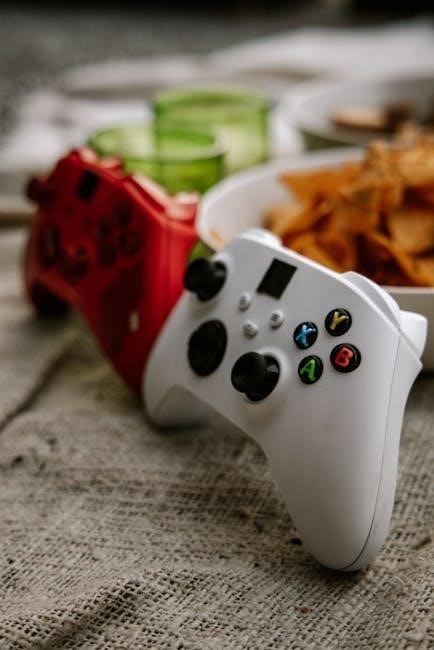
Dive into the world of seamless gaming with a 2.4G wireless controller gamepad! This guide unveils the freedom of untethered play, offering a comprehensive look at its features and setup.
What is a 2.4G Wireless Controller?
A 2.4G wireless controller represents a significant leap in gaming convenience, offering a cable-free experience for enhanced immersion. Unlike Bluetooth controllers, 2.4G utilizes a dedicated wireless frequency, typically providing a more stable and responsive connection with lower latency. This technology establishes a direct link between the gamepad and a USB receiver, minimizing interference and ensuring precise control during gameplay.
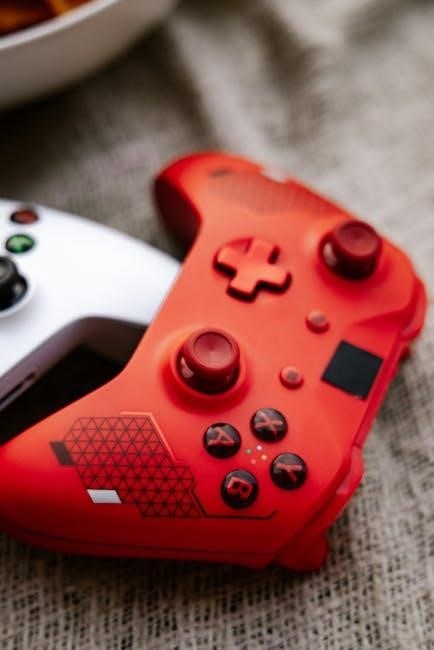
These controllers are designed for compatibility across various platforms, including PCs, and gaming consoles like the Nintendo Switch, eliminating the need for cumbersome wires. The “2.4G” designation refers to the radio frequency band used for communication, known for its reliability and range. This makes it an ideal choice for gamers seeking a lag-free and unrestricted gaming session, offering freedom of movement and a cleaner setup.
Key Features and Benefits
The 2.4G wireless controller gamepad boasts several key features enhancing the gaming experience. Foremost is its wireless freedom, eliminating cable clutter and allowing for comfortable, unrestricted play. Expect low latency, ensuring responsive controls crucial for fast-paced games. Many models include a turbo function, enabling rapid button presses with a single hold – a boon for action titles.
Beyond performance, these controllers often feature ergonomic designs for extended comfort. Adjustable sensitivity settings (where available) allow customization to suit individual preferences. The plug-and-play functionality, with a simple receiver connection, simplifies setup. Benefits include increased portability, a cleaner gaming space, and a more immersive experience. Ultimately, a 2.4G controller delivers convenience, precision, and customization for gamers of all levels.
Compatibility: Devices Supported
This 2.4G wireless controller gamepad demonstrates broad compatibility, extending beyond just PCs. A primary supported device is the Nintendo Switch, offering a wireless alternative to Joy-Cons with a straightforward pairing process – simply plug in the receiver and press the home button. Many controllers also seamlessly connect to Windows-based computers, requiring minimal driver installation for plug-and-play functionality.
While primarily designed for these platforms, compatibility can extend to Android devices, though specific models and configurations may vary. Some controllers may require additional software or adapter for optimal performance on mobile platforms. It’s crucial to verify compatibility with your specific device before purchase. Generally, any device with a USB port capable of accepting the 2.4G receiver should function, providing a versatile gaming solution.
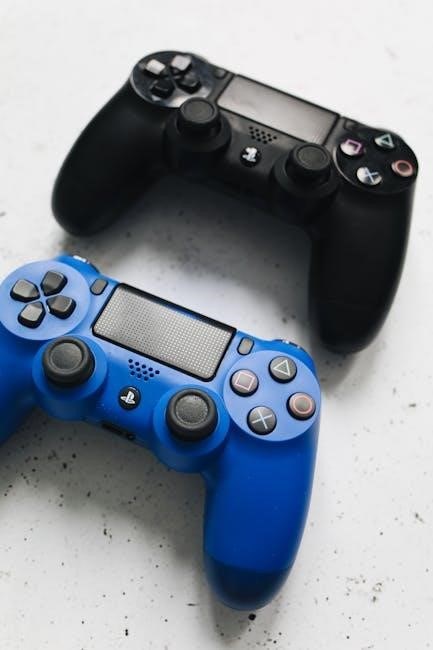
Package Contents & Controller Overview
Unbox your new gaming experience! The package includes the gamepad, a 2.4G receiver, and essential documentation for quick setup and optimal performance.
Unboxing: What’s in the Box?
Carefully open the packaging to reveal the core components of your new 2.4G Wireless Controller Gamepad. You should find the gamepad itself, ergonomically designed for comfortable extended play sessions. A crucial element is the included 2.4GHz wireless receiver – a small USB dongle that establishes the connection between the controller and your gaming device.
Don’t overlook the accompanying documentation! A user manual provides detailed instructions on pairing, button configurations, and troubleshooting. Some packages may also include a quick start guide for immediate setup. Depending on the model, you might find additional items like a USB charging cable (if the controller has a rechargeable battery) or extra thumb grips for enhanced control. Verify all components are present to ensure a complete and satisfying unboxing experience, preparing you for hours of wireless gaming enjoyment.
Controller Layout: Identifying Buttons & Components (A-E)
Familiarizing yourself with the controller’s layout is key to maximizing your gaming experience. The 2.4G Wireless Gamepad features five main areas, designated A through E, representing distinct input functionalities. Area A typically encompasses the directional pad (D-Pad), crucial for precise movement and menu navigation. Area B houses the primary action buttons – often including A, B, X, and Y – used for in-game interactions.
Area C usually features the analog sticks, enabling nuanced control over character movement and camera perspectives. Area D contains shoulder buttons (L1/R1) and triggers (L2/R2), providing additional action inputs. Finally, Area E includes the central function buttons like ‘Home’, ‘Select’, and ‘Start’, alongside the power button. Understanding the placement and purpose of each component (A-E) will quickly enhance your gameplay and unlock the controller’s full potential.
Receiver Unit: Function and Connection
The 2.4G receiver is the vital link enabling wireless communication between your gamepad and the host device. This small USB dongle captures signals transmitted by the controller, translating them into actionable commands. For initial connection, simply plug the receiver into a compatible USB port on your device – whether it’s a PC, Switch, or other supported platform.
Upon insertion, the receiver typically initiates a search for a paired controller. The LED indicator on the receiver will often blink during this process. Ensure the receiver is securely connected for a stable signal. Interference from other wireless devices can sometimes occur, so positioning the receiver away from potential sources is recommended. Proper receiver function is crucial for a lag-free and immersive gaming experience.
Initial Setup & Pairing
Begin your gaming journey by connecting the 2.4G receiver and pairing the controller with your desired device for a seamless, wireless experience.
Connecting the 2.4G Receiver
The 2.4G receiver is the crucial link enabling wireless communication between your gamepad and your gaming device. Typically, this small USB dongle plugs directly into an available USB port on your console, PC, or other compatible device. Ensure a secure connection for optimal performance.
For Nintendo Switch, insert the receiver into the dock or a USB port while the console is powered on. On a PC, simply plug it into a free USB port; the system should automatically detect the receiver. If not, driver installation might be necessary (covered later).
Avoid using USB hubs initially, as direct connection to the device often provides the most stable signal. Once connected, observe the receiver’s LED indicator – it usually blinks to signify it’s ready for pairing with the controller. Proper receiver connection is the foundation for a lag-free gaming experience.
Pairing the Controller with a Device (Switch Example)
To pair your 2.4G wireless controller with a Nintendo Switch, begin by ensuring the receiver is firmly connected to the Switch dock or a USB port. Power on your controller by pressing the Home button; the controller’s LED indicators will initiate a searching sequence, typically a rapid blinking pattern.
On the Switch, navigate to System Settings, then Controllers and Sensors, and select “Change Grip/Order.” Press the SYNC button on the Switch (located inside the Joy-Con rails). The Switch will begin searching for available controllers.
Within moments, the controller’s LED indicators should transition to a solid blue light, confirming a successful connection. The controller will now appear as a connected Pro Controller within the Switch’s settings. Repeat this process for additional controllers. A stable pairing ensures seamless gameplay!
LED Indicators: Understanding the Lights
The LED indicators on your 2.4G wireless controller provide crucial feedback regarding its status. A rapidly blinking blue light generally signifies the controller is in pairing mode, actively searching for a compatible device. Once paired successfully, the LED will typically illuminate with a solid blue hue, confirming a stable connection.
A red blinking light often indicates low battery levels, prompting you to connect the controller for charging. During the charging process, the LED may pulse or display a different color, such as orange, to denote charging progress.
If the LED remains off after powering on the controller, verify it’s adequately charged or troubleshoot potential power issues. Understanding these light patterns is key to efficient operation and quick problem-solving during your gaming sessions.
Installation & Driver Setup
Ensure optimal performance by installing the necessary drivers. Access controller settings via the START menu after a successful Cosmic Byte driver installation from the provided CD.
Driver Installation (Cosmic Byte Example)
To begin driver installation for your 2.4G Wireless Gamepad (using Cosmic Byte as an example), first locate the included CD. Insert the CD into your computer’s optical drive. Browse the CD’s contents and double-click the “Setup” file. This will launch the Cosmic Byte driver installation wizard.
Follow the on-screen instructions carefully throughout the installation process. You may be prompted to accept a license agreement and choose an installation directory. It’s generally recommended to accept the default settings unless you have a specific reason to change them.
The installation wizard will copy the necessary driver files to your computer. Once the installation is complete, you may be asked to restart your computer. Restarting is often required for the driver to function correctly. After restarting, your controller should be recognized by your system.
Accessing Controller Settings
After successfully installing the Cosmic Byte driver for your 2.4G Wireless Gamepad, accessing the controller settings allows for customization of your gaming experience. To open the settings panel, simply click the “START” button on your computer. Navigate through the Start Menu to find the Cosmic Byte folder, typically located within the list of installed programs.
Within the Cosmic Byte folder, locate and click on the “Controller Settings” or a similarly named application. This will launch a dedicated window where you can configure various aspects of the gamepad. Available settings may include button mapping, sensitivity adjustments, and turbo function configuration.
Explore the different tabs and options within the settings window to personalize the controller to your preferences. Save any changes you make before exiting the settings panel to ensure they are applied.
Troubleshooting Driver Installation Issues
Encountering problems during driver installation for your 2.4G Wireless Gamepad? First, ensure the receiver is securely connected to your computer. If the installation fails, try running the setup file as an administrator – right-click and select “Run as administrator.” Temporarily disable any antivirus software, as it might interfere with the process;
If issues persist, download the latest driver version directly from the Cosmic Byte website, avoiding third-party sources. A corrupted download can cause installation errors; Before reinstalling, completely uninstall any previous driver versions through the Control Panel’s “Programs and Features” section.
Check Device Manager for any unrecognized devices or error codes related to the gamepad. Updating your operating system can also resolve compatibility issues. If all else fails, consult the Cosmic Byte support website for further assistance.
Basic Controller Operation
Mastering the fundamentals is key! Power on with the ‘Home’ button, navigate using the analog stick and D-pad, and explore each button’s unique function.
Powering On/Off the Controller
Initiating gameplay is simple: a single press of the ‘Home’ button instantly powers on your 2.4G wireless controller. Observe the LED indicators to confirm successful activation – a steady light typically signifies readiness. To conserve battery life when not in use, press and hold the ‘Home’ button for approximately three seconds.
The LED indicators will then extinguish, confirming the controller has been powered down. It’s crucial to fully power off the controller when storing it for extended periods to prevent accidental battery drain. Some controllers may feature an auto-sleep function, activating after a period of inactivity. Remember to check your specific model’s documentation for details regarding this feature and optimal power management practices. Proper power cycling ensures longevity and reliable performance.
Button Functions: A Detailed Guide
The 2.4G Wireless Gamepad boasts a comprehensive button layout designed for intuitive control. The primary face buttons – typically labeled A, B, X, and Y – facilitate core game actions like jumping, attacking, and interacting. Shoulder buttons, often designated as L1/R1 and L2/R2, provide additional inputs for actions such as aiming or accelerating.
The directional pad (D-Pad) enables precise movement, while analog sticks offer nuanced control for character navigation and camera manipulation. The ‘Home’ button powers the controller and initiates pairing. ‘Select’ and ‘Start’ buttons often access in-game menus. Understanding each button’s function is key to maximizing your gaming experience. Refer to specific game instructions for customized button mappings.
Analog Stick & D-Pad Usage
Mastering the analog sticks and D-Pad unlocks precise control within your games. Analog sticks allow for 360-degree movement, offering variable speed and direction based on deflection. Gently tilting the stick results in slower movement, while fully pushing it maximizes speed. They are ideal for character locomotion and camera control.
The D-Pad, conversely, provides digital directional input – up, down, left, or right. It’s perfect for menu navigation, selecting items, or executing specific in-game commands requiring precise directional input. Experiment with both input methods to discover what feels most comfortable and effective for each game. Fine-tune your control for optimal performance!
Advanced Features & Customization
Unlock your gamepad’s full potential! Explore turbo functions, sensitivity adjustments, and profile settings for a personalized gaming experience tailored to your preferences.
Turbo Function: Configuration & Use
The turbo function allows for rapid, continuous button presses with a single hold, ideal for fast-paced action games. To configure, typically you’ll need to press and hold the ‘Turbo’ button, then the button you wish to assign the turbo function to. A visual indicator, like a flashing LED, often confirms successful assignment.
Different controllers offer varying turbo speeds – some allow cycling through speeds by repeatedly pressing the ‘Turbo’ button after assignment. Experiment to find the optimal setting for your game and playstyle. To deactivate turbo on a specific button, repeat the assignment process. Remember that not all games fully support turbo functionality, and its use may be considered cheating in some online environments. Always check game-specific rules before utilizing this feature.
Sensitivity Adjustment (If Applicable)
Some 2.4G wireless gamepads offer adjustable analog stick sensitivity, allowing you to fine-tune movement precision. This feature is particularly useful for games requiring delicate aiming or precise control. Adjustment methods vary; some controllers utilize dedicated sensitivity buttons, often in combination with the analog sticks themselves.
Typically, pressing a sensitivity button while moving the stick adjusts the sensitivity level. An on-screen display or LED indicators may show the current setting. Higher sensitivity means smaller stick movements result in larger in-game actions, while lower sensitivity provides more granular control. Experiment with different settings to find what best suits your preferences and the specific game you’re playing. Remember to reset to default settings if needed, and consult the controller’s full manual for detailed instructions.
Profile Settings (If Supported)
Advanced 2.4G wireless gamepads may support profile settings, enabling customized button mappings and configurations for different games or players. These profiles allow you to save preferred control schemes, eliminating the need to reconfigure settings each time you switch games. Accessing profile settings usually involves dedicated software on your PC or through a combination of button presses on the controller itself.
Within the profile settings, you can typically remap buttons, adjust analog stick sensitivity, and configure turbo functions. Some controllers allow multiple profiles to be stored, accessible via a profile selection button. Saving profiles ensures a personalized gaming experience tailored to your specific needs. Refer to the controller’s manual for detailed instructions on creating, editing, and switching between profiles, maximizing your gameplay customization.
FCC ID & Regulatory Information
This device adheres to FCC regulations, identified by FCC ID 2AEBYEG-C3054Y. Compliance ensures safe operation and minimizes potential interference with other devices.
FCC ID 2AEBYEG-C3054Y Explained
The FCC ID, 2AEBYEG-C3054Y, is a unique identifier assigned by the Federal Communications Commission to ShenZhen Targetever Technology Co., Ltd., the manufacturer of this 2.4G Wireless Gamepad. This ID is crucial for verifying the device’s compliance with U.S. electromagnetic interference standards. It signifies that the gamepad has undergone testing and meets the FCC’s requirements for safe radio frequency emissions.
This identification number allows the FCC to track the device and ensure it doesn’t cause harmful interference with other electronic equipment. Consumers can use this FCC ID to search the FCC database for detailed information about the product, including testing reports and specifications. It’s a key component of regulatory compliance, assuring users of the product’s safety and adherence to established guidelines. Understanding the FCC ID provides transparency and confirms the gamepad’s legal operation within the United States.
Compliance Information
This 2.4G Wireless Gamepad is designed to comply with established regulatory standards, ensuring safe and reliable operation. It adheres to FCC Part 15 regulations, governing unintentional radiators, minimizing potential interference with other devices. The product also meets relevant safety standards, prioritizing user well-being during operation.
ShenZhen Targetever Technology Co., Ltd. confirms this gamepad has been tested and verified to meet these requirements. Compliance extends to electromagnetic compatibility (EMC) directives, ensuring the device functions harmoniously within an electromagnetic environment. Users are advised to operate the gamepad within specified parameters to maintain compliance. Modifications without explicit approval could void compliance and potentially lead to interference. This commitment to compliance guarantees a quality user experience and responsible product stewardship.
Safety Precautions
To ensure safe and enjoyable use of your 2.4G Wireless Gamepad, please adhere to the following precautions. Avoid exposing the controller to extreme temperatures or humidity, as this can damage internal components. Do not disassemble the device; unauthorized repairs may void the warranty and pose safety risks.
Keep the controller away from liquids to prevent electrical shock or corrosion. Clean the controller with a soft, dry cloth; avoid abrasive cleaners. Prolonged use should be interspersed with breaks to prevent repetitive strain injuries. Supervise children when using the controller, ensuring they understand proper handling. Dispose of the controller responsibly, following local electronic waste regulations. Do not attempt to replace the battery yourself; contact qualified personnel for assistance. Prioritizing these safety measures guarantees a secure gaming experience.
Troubleshooting Common Issues
Encountering problems? This section provides solutions for connectivity, responsiveness, and battery concerns, ensuring a smooth gaming experience with your 2.4G gamepad.
Controller Not Connecting
If your 2.4G wireless controller fails to connect, begin by verifying the receiver is securely plugged into your device. Ensure the controller has sufficient battery charge; low power can hinder pairing. Attempt re-pairing the controller – press the home button on the controller while the receiver’s LED is blinking.
Confirm your device supports 2.4G wireless controllers. Interference from other wireless devices can sometimes disrupt the connection; try moving away from potential sources. For Switch, ensure the receiver is inserted correctly, initiating the pairing process with blinking blue LEDs on both units.
If issues persist, try a different USB port for the receiver. A driver reinstall (refer to the ‘Installation & Driver Setup’ section) might resolve compatibility problems. Finally, check for firmware updates for both the controller and your gaming device.
Button Responsiveness Problems
Experiencing unresponsive buttons on your 2.4G wireless gamepad? First, ensure there’s no physical obstruction or debris interfering with the button presses. Low battery levels can also cause erratic behavior, so charge the controller fully. Check for driver conflicts or outdated drivers; reinstalling the driver (see ‘Installation & Driver Setup’) is a good first step.
Interference from other wireless signals can sometimes lead to input lag or missed inputs. Try reducing the distance between the controller and the receiver, and minimize potential sources of interference. If the problem persists, test the controller on a different device to isolate whether the issue lies with the controller itself or the original gaming system.
Consider recalibrating the controller within your device’s settings, if available. A factory reset of the controller (consult the manual for specific instructions) might also resolve persistent responsiveness issues.
Battery Life Issues & Charging
Reduced battery life on your 2.4G wireless gamepad is a common concern. Several factors can contribute to this, including prolonged use, high volume settings (if applicable with built-in speakers), and constant vibration feedback. To maximize battery life, reduce vibration intensity or disable it entirely within game settings.
Always use the provided USB cable for charging; third-party cables may not deliver optimal power. A full charge typically takes 2-3 hours, indicated by a change in the LED indicator (refer to ‘LED Indicators’). Avoid overcharging the controller, as this can potentially degrade battery health over time.
If the controller isn’t charging, try a different USB port or cable. If issues persist, contact customer support, as a failing battery may require replacement.